Mini Goldendoodle Full Grown Size Chart: A Complete Guide (2025)
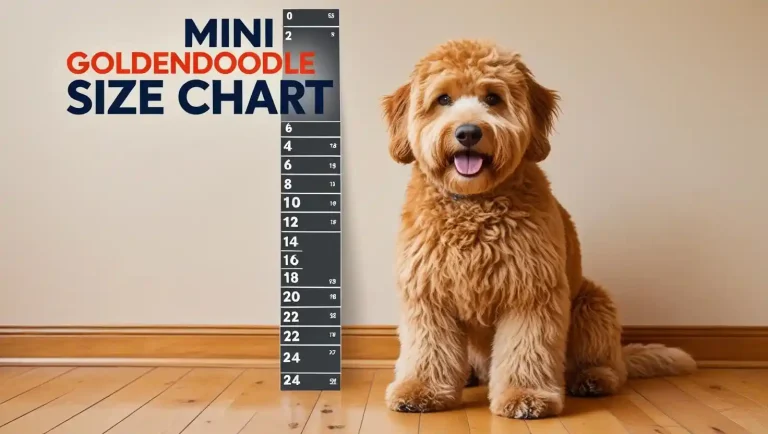
In this Guide of Mini Goldendoodle full grown we will discuss all that you must know regarding that cute furry pet of yours. A full grown Goldendoodle ranges between 13 to 20 inches in both height and weight of 15 to 35 pounds, depending on the genetics and what they are fed. Typically, the vast majority of the Mini Goldendoodles are going to be within the typical adult size for them that is 11-13 months although they will continue to fill-out until 18 months. This complete guide contains all the information you require concerning Goldendoodle full grown size together with an elaborate size chart to show how it grows with age.
How Big Its Size by Age, Height and Weigh?
Micro Goldendoodles are adorable because they are small, fluffy, and they are very loving. However, being aware of the size they are going to get and when they will get this size is also necessary as it is needed to prepare adequate food and the size of the crates that will be needed to the way they need to be groomed as well as their predisposing to the conditions of the living space. Below is the size chart of Mini Goldendoodle.
Size Chart Birth to 12+ Month
| Mini Goldendoodle Age | Height (inches) |
| Birth to 02 week | NA |
| 08 week | 04 to 08 inches |
| 03 Month | 08 to 10 inches |
| 06 Month | 10 to 15 inches |
| 09 Month | 11 to 18 inches |
| 12/Beyond Month | 12 to 21 inches |
Average Height
An adult Mini Goldendoodle normally reaches 13-20 inches high when in a standing posture or at the Shoulders. It is a height taken to the ground to the top of their shoulders. The mini Goldendoodles can live in an apartment but they are tall enough to be robust and playful. Their size depends very much on that of their parents, their Poodles and Golden Retriever.
Average Weight
Most Mini Goldendoodle grows to be between 15 and 35 pounds in their adulthood. It is at large that the men would lean on the heavier side of the scale as the ladies can be a bit lighter. The critical determinants in the area come in with your puppy. Is it a cross breed of a Toy Poodle? Then you will get the lower range or the larger one that is your parent a Mini Poodle so then you’re more likely to get the higher range.
Miniature Goldendoodle Temperament and Personality
Mini Goldendoodles are loving, faithful and outgoing when they have grown up. Their personality can be described as a combination of the smartness of the Poodle and the soft heart of the Golden Retriever. Majority of the adult mini goldendoodles are family oriented and can adapt to children with ease and live on attention and play. They grow to be relaxed as they age yet they enjoy having people around them all the time hence they are among the best companion breeds to both families and single people.
Growth Stages of a Mini Goldendoodle Puppy
Life with a Mini Goldendoodle is full of cuddles and milestones or even curiosity. One question every pet parent is asked when they have a small fluff ball is when the pet should finally stop growing and how they can help their pet through the process. Being one-time doodle owner or just interested in what to expect only by reading more about doodle and its development, by knowing more about their evolution, you can treat them with ease.
This is what you as a puppy owner should expect with your pet dog as it grows through each stage of life:
0 to 06 Month Puppy (Stage 01)
This is the softest and touching stage. Your Mini Goldendoodle arrives into the world as an adorable little bundle of energy, which is not going to get any smaller or mellow over the coming months. In these initial months they are heavily dependent on their surroundings and you. Normally, they may grow so fast in terms of height and weight to the extent they can increase by twice the normal size in a span of 8 to 16 weeks.
During Stage 1 (0 to 6 Month):
- They socialize, start learning the simple commands, and get used to routines
- It is important to provide proper nutrition related to the bones and joints development
- Early check-ups and vaccination visits in a vet should get priority
Their short paws and floppy ears may only deceive you, but you should not be mistaken with the speed of their growing during this period. One hug is all that it takes!
06 to 12 Month Teenage (Stage 2)
Think of this as middle school-awkwardness. Your pup is bigger than tiny—but not yet and adult. They will begin testing limits, displaying bits of streaks of independence and curiosity. You’ll see their body changing right before your eyes with them having more defined shape, longer legs stronger muscles and a more confident strides.
During Stage 2 (06 to 12 Month):
- Regular practicing and enforce of rules
- Baby may still teething (teething toys are good!)
- Natural desire for sex.
It is also when a lot of dog parents start asking the question: “How big will my mini Goldendoodle be?” They’re still growing and from where they are now to their size today they still have some growing left.
12 to 18 Month and Beyond Adult (Stage 3)
At this point, your Goldendoodle is not only an active puppy anymore but a peaceful pet. In a physical sense, they have already attained close to final proportions though there could be a little bit more infilling till about 18 months. Their zest is still playful, yet you are going to see more expectation in how and what they are going to spend their energy.
During Adulthood:
- Their metabolism becomes steady and they therefore might require diet rehold
- Regular physical activity is important not to put on weight
- Consistent veterinary treatment benefits in the development of long-term health
Expert Thoughts on Fully Grown Mini Goldendoodle
Being aware about the development will help you provide your Mini Goldendoodle with optimal care. The process has its trials and tribulations, as every stage will present its own joys and woes, but through the challenges, you will see your pup become a family companion full of love and loyalty.
Are you concerned about the time when your Goldendoodle will stop growing in size?- Monitor and understand that, it will just happen slowly but perfectly. The only thing that matters is the time, care and love which you invest in their path.
What Factors Affect On Its Growth and Size?
It is not all about intellectual curiosity just to know about what influences adult size of your puppy but is about taking care of them. Every doodle is a unique realization of life, biology and love. So you are constantly wondering how big your growing puppy will be? Or, how big will they would be? Well this guide helps see how big they will grow, and more importantly make sure they grow up to a healthy happy bond.
So, what are the main factors affecting the outcomes of your Mini Goldendoodle full grown in terms of physical appearance and development? Let us have a close look.
Health And General Development Issues
Fully grown Mini Goldendoodle should have a consistent growth during 0 to 18 months. The gain of weight or the weakness of bones may be the symptoms of overfeeding or lack of the nutrients. Their growth pattern is sometimes influenced by common problems such as hip dysplasia, allergies or joint pain. Frequent visits to the veterinary, healthy diet and exercise will make sure that growth will be healthy and constant.
Genetics and Parent Breeds
Each and every Goldendoodle has its background story-written by their parents. The biggest influence on how big your puppy of a Poodle and a Golden Retriever will grow is the size of your doggies ancestors.
- Parents tend to have smaller offspring and nature may trick us with exceptions.
- In case one of the parents is a Toy or a miniature Poodle, prepare a smaller frame.
- Genes provided by the Golden Retriever parent such as longer legs or full chest might end up contributing to overall build.
Genetics make the base outline, and it only forms one part of the puzzle. Even litter siblings can end up radically different just as the case is with human siblings.
Type of generation (F1, F1B, F2 and so on)
Have you ever heard of breeders talking of F1 or F1B? These generational tags help us know the percentage of Poodle and Golden Retriever DNA in your dog and that proportion has a direct impact on the coat, temperament and, for sure, the size.
- F1 (50 percent Golden Retriever, 50 percent Poodle) -Usually even on features and size.
- F1B (75% Poodle, 25% golden retriever), Usually smaller and curlier avec au Poodle influence more.
- F2 or F2B- this one can vary over a broader range since it is mixed-lineage.
The greater the percentage of Poodle, the more likely your Mini Goldendoodle will become on the smaller side. However, take note that they are patterns not promises.
Diet and Nutrition of Teacup Goldendoodle Full Grown
Goldendoodles like us grow up well when feed well. The nutrition of your dog in puppy and adolescent stages influences their body in a very deep manner.
- A good nutritious diet including quality proteins and essential fat contributes to developing strong bones and healthy muscle growth.
- Malnutrition instead could lead to the stunted growth or joint problems in the future.
- Do not make her fat- being fat is not the same as healthy.
Right food is not only a matter of size. It is about making your dog healthy head to tail.
Exercise and Daily activity
Exercise is not only fun but it is one way in which your Goldendoodle builds muscles. Adequate exercising enhances bone strength, muscle tones, and aids in positive mindset.
- Light, everyday walking (such as strolls, gentle playing fetch or swimming) is the best.
- Puppies require short and frequent play time as opposed to vigorous activity.
- It should be balanced as the stress injury can be formed when young joints are over exercised.
Consider the exercise as molding the clay: it molds the body as well as the behavior of the individuals slowly.
Feeding And Nutrition Tips
In order to keep the energy up without gaining weight, Adult Mini Goldendoodles should include a high-protein and moderate-fat diet. Give them 1 to 1.5 cups of good quality kibble 2 times a day. Select dog food which promotes joint health and coat shine. Human snacks should be avoided and the amount of portions need to be monitored to avoid obesity. The regularity of food intake leads to normal metabolism and a healthier and extended life.
Regular health checkup of Mini Goldendoodle
Regular vet check-ups are not just a formality, it is your first line of prevention regarding growth inconveniences. Your vet will be able to monitor the developing animal and can suggest supplements where necessary and can treat any ailments that may hinder growth.
- Others like worms or parasites could quietly drain the nutrients and obstruct weight gain.
- Testing and scan at an early age make it possible to change the approach to care regarding genetic disorder.
- The vaccination regimes and concurrent evaluations will make sure your pup gets to grow as it should.
The advice given by a vet is not limited to medicine it is a relief.
Living conditions and environment Education and Training
The location and mode of raising up your Mini Goldendoodle is important. The physical and emotional growth can take place with a loving, clean and enriched home environment.
- A stress-free environment enhances good digestion and hormone balance that is important in steady growth.
- Pollution of clean water, bedding and grooming leads to the reduction of risks of illness.
- Love, games, and exercise are all activities that will produce an all rounded dog.
Your house is where your doodle has to turn into a world, make it secure, fun, and peaceful.
How to Guess Adult Size?
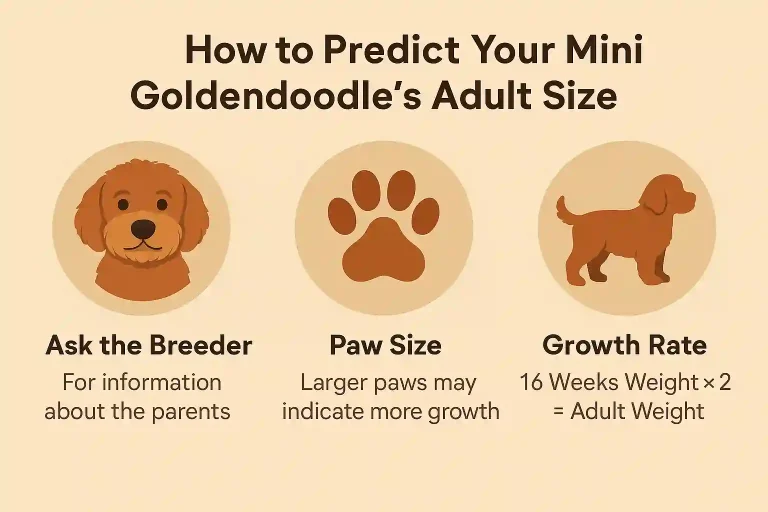
Bringing a home a Mini Goldendoodle puppy makes you excited- and leaves you with questions. It is one of the largest? What is going to be the size of my fur baby? Although you can use no crystal ball, there are several sure methods that you can use to tell how your Mini Goldendoodle will end up once it matures. So, let us discuss them by article as a visit to the future of your puppy.
Request Some Parental Details with Your Breeder
The initial and the most credible hint is? Your breeder. Breeders that are worth their reputation maintain records about both parents, their height, weight and generation (F1, F1B, etc.). Because your pup will have genetic factors of both parents, it will be a good ball park to know the size of both parents.
To give an example, in case one of the parents is Toy Poodle and the other is smaller Golden Retriever, there is likelihood that your Mini Goldendoodle can remain on the smaller side of the spectrum. This will make this first observation be helpful as it would enable you to prepare your house, select an appropriate crate and future grooming needs.
Look at the size of paws
This is a cute trick that makes many first-time dog parents surprised: see the paws!
When your pup seems to have big paws as compared to the rest of their body, they probably are not completely grown up. Nature is not precise science nonetheless, it balances things. Big paws = big Things to come. This observation alone will give you a clue in real time as well as providing some cute photos along the course.
Observation of Growth Rate in puppyhood
You should expect major growth spurts of your Mini Goldendoodle within a span of 0 12 months, with the most active growth being at weeks 8-20. Monitor their weights after every 2-4 weeks. Puppies that grow heavy in the early years become larger when they mature.
You may even apply such simple growth formulas as:
Adult Weight = 16 Weeks Weight (2)
It is a rule, but in many cases not wrong enough to forewarn you against something.
Focusing on these dog pregnancy signs, you will not only be able to forecast the size; you will feel more involved in the process of your Goldendoodle. It also makes you and a lifelong best friend besides having to be pet owner.
Hint: Do not blame a particular approach, you should use all of them to have a better idea of what your Mini Goldendoodle will look like once it grows up.
Conclusion
Waiting to see your Mini Goldendoodle through development as a fancy, wriggly puppy to a brave, adult lover is one of the sweetest types of experiences a dog lover can acquire. They do not physically change only, but also their emotions change.
Each development stage, each wagging tail, each milestone in between is a connection that cannot be explained but strongly sensed. Knowing their size chart, growth stages, and the numerous factors that determine their development, you learn not only numbers; you get ready to ease their being, health, and happiness at every step. Even though your Mini Goldendoodle will fall on either end of the size scale, the bottom line is how you remain present with them as they mature. As you fill them, so shall fill your heart.
But mark this: when you start to doodle you never do the same doodles twice–and that is one of the spells. Love them, treat them well, and be patient- they will give you life long love, humor and hugs.